

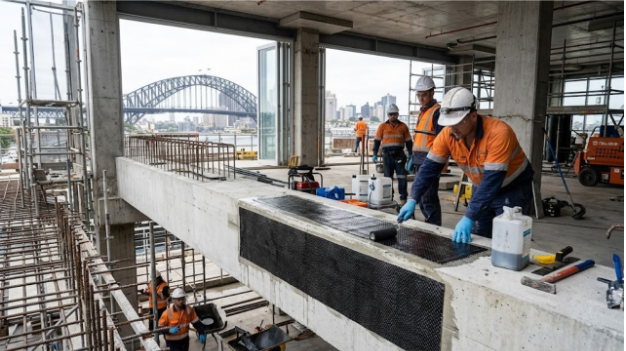
Buildings are designed to carry loads safely throughout their intended service life, but structures do not remain exactly the same from the day they are completed. Changes in building use, ageing concrete, corrosion, environmental exposure, accidental damage and alterations can all affect structural performance.
A building that was suitable for its original purpose may later require additional structural capacity. A warehouse might receive heavier equipment, a commercial property may undergo refurbishment, or an older concrete structure may show signs of deterioration. In other cases, an inspection may identify damage that requires engineering intervention before the building can continue operating safely.
This is where structural building strengthening Sydney becomes an important part of remedial engineering. The objective is not simply to add more material to a building. It is to identify the structural deficiency, establish the required performance and develop a strengthening solution that works with the existing structure.
Strengthening starts with finding the reason
One of the biggest mistakes in structural repair is treating visible damage as the complete problem.
A crack in a beam, slab or column can be associated with several different conditions. Reinforcement corrosion, excessive loading, inadequate original detailing, changes to building use, impact damage and long term deterioration can all contribute to structural problems. A strengthening solution needs to consider the reason behind the defect before work begins.
For this reason, a professional assessment may examine the existing drawings, site conditions, structural elements, loading requirements, previous repairs and visible deterioration. Where necessary, additional investigation and testing can provide information that cannot be obtained from a visual inspection alone.
The result should be a clear picture of what the structure is doing, what has changed and what the strengthening work needs to achieve.
Five situations that can lead to structural strengthening
Structural strengthening can become necessary for different reasons. Some projects involve older buildings, while others are connected with planned changes to a property.
1. A change in building use
A building designed for one purpose may later be used for something that creates different loading conditions.
Additional plant, storage systems, mechanical equipment or other installations can increase loads on floors and supporting elements. Before making such changes, the existing structure may need to be assessed to determine whether additional capacity is required.
This is particularly relevant for commercial, industrial and warehouse properties where operational requirements can change significantly over time.
2. Building refurbishment or alteration
Removing walls, creating openings, changing floor layouts or modifying structural elements can affect the load path through a building.
An alteration that appears relatively small from an architectural perspective may have significant structural consequences. Columns, beams, slabs and supporting walls can all contribute to the way loads are transferred through the building.
Early structural involvement helps identify these issues before construction creates a larger problem.
3. Deterioration and corrosion
Concrete deterioration can reduce the effective condition of a structural element. Reinforcement corrosion is one common cause of concrete damage, particularly where moisture and environmental exposure contribute to corrosion processes.
As reinforcement corrodes, the resulting expansion can contribute to cracking, delamination and loss of concrete around reinforcement. The appropriate response depends on the severity and extent of deterioration.
Strengthening may form part of the repair strategy after the damaged concrete and reinforcement condition have been properly assessed.
4. Damage caused by an incident
Structural elements can be affected by vehicle impact, fire, accidental damage, construction activities or other unexpected events.
After an incident, the priority is to establish the condition of the affected element before deciding how it should be repaired. Depending on the damage, the solution could involve concrete repair, replacement, strengthening, temporary support or a combination of engineering measures.
5. Ageing structures
Older buildings can present different engineering challenges from recently constructed structures.
Original drawings may be incomplete, materials may have deteriorated and previous modifications may not be fully documented. A detailed investigation can help establish the existing condition and provide evidence for any proposed strengthening work.
This is particularly important when an older property is being refurbished or adapted for a new use.
What does structural strengthening actually achieve?
Structural strengthening aims to improve the capacity, performance or durability of an existing structural element in line with the engineering requirements of the project.
The method depends on the structure and the problem being addressed.
Common approaches can include:
| Strengthening method | Potential application |
| Carbon fibre strengthening | Improving the capacity of suitable concrete elements |
| Steel strengthening | Providing additional structural capacity |
| Concrete repair | Restoring deteriorated sections before further strengthening |
| Structural modifications | Altering load paths or supporting arrangements |
| Post tension repair | Addressing defects affecting post tensioned structures |
| Additional structural members | Providing new support where appropriate |
| Localised strengthening | Addressing a specific deficient area |
No single strengthening system is suitable for every building.
The existing concrete, reinforcement arrangement, loading, access conditions, required capacity and project constraints all need to be considered.
Carbon fibre strengthening can provide a practical option
Carbon fibre reinforced polymer systems are used in structural engineering for certain strengthening applications. They can provide additional tensile capacity while adding relatively little weight to the structure.
For suitable applications, carbon fibre systems can be installed to strengthen concrete beams, slabs, columns and other structural elements.
One of the advantages can be the relatively low physical impact on an existing building. However, the system still needs to be designed and installed according to the requirements of the specific structure.
The important point is that carbon fibre is a structural engineering system, not simply a material that can be applied where
Contact Us
If an existing concrete structure is showing signs of deterioration, has experienced damage, or needs additional capacity for a new building requirement, Concrete Engineering Solutions can assist with specialist structural assessment and remedial engineering services.
Concrete Engineering Solutions works with existing site conditions to identify the engineering requirements and develop a practical path forward for the building or structure.
If you have concerns about the condition, performance or capacity of a building in Sydney, contact Concrete Engineering Solutions to discuss the site, the structural issue and the engineering support required.